“I am worried.”
“About what?”
“That I am going to get fired.”
or
“That I am going to fail this exam.”
or
“That I will embarrass myself at tomorrow’s event and everyone will judge me.”
We have all felt worried at some point or another about something that might happen in the future – before an exam, work review, or a social gathering. It’s a normal emotional response to uncertainty we may not be comfortable with.
When this worry starts to take over and we feel constantly nervous, excessively worried/concerned, or physically tense, we may be experiencing anxiety.
The Oxford Dictionary defines anxiety as “the state of feeling nervous or worried that something bad is going to happen.” It is often accompanied by physical symptoms such as tense muscles, quick breathing, and a fast heartbeat. And unlike fear — which is a short, direct reaction to a clear and immediate danger — anxiety is a longer-lasting feeling linked to potential future threats.
This anxiety is essentially an adaptive biological response to real threats, proportionate to the situation, and resolves once the stressor passes without major disruption to daily life. It’s a stronger response to stressors as compared to worry, but it’s still manageable without outside intervention.
In fact, this biological mechanism has been a survival tool throughout human evolution, helping early humans anticipate dangers, prepare for threats, and stay vigilant in uncertain environments.
But if the progression continues, that is, if the feelings of worry and nervousness further intensify and persist, it’s a cause for concern and we may need outside help.
How to know when to seek help for worry or anxiety?
When our adaptive anxiety becomes intense, long-lasting, and starts affecting how we live, it may go beyond and turn into clinically significant anxiety, i.e. anxiety where a clinical intervention is required.
Clinically significant anxiety involves excessive, persistent worry that is disproportionate to actual threat and causes significant interference with work, relationships, or personal life, which is different from adaptive anxiety in that that adaptive anxiety is proportionate to actual danger, improves when the threat passes, and doesn’t significantly interfere with daily functioning.
Clinically, Anxiety or Generalized Anxiety Disorder (GAD), is characterized by excessive fear and worry, combined with avoidance behaviors and physical symptoms. An individual is said to have an anxiety disorder when they experience (i) Excessive anxiety and worry occurring on more days than not for at least 6 months, (ii) Difficulty controlling the worry, (iii) Physical symptoms such as restlessness, fatigue, difficulty concentrating, irritability, muscle tension, or sleep disturbance, and (iv) Significant impairment or distress in social, occupational, or other important areas of functioning. Further, these symptoms must not attributable to substance use or another medical condition.
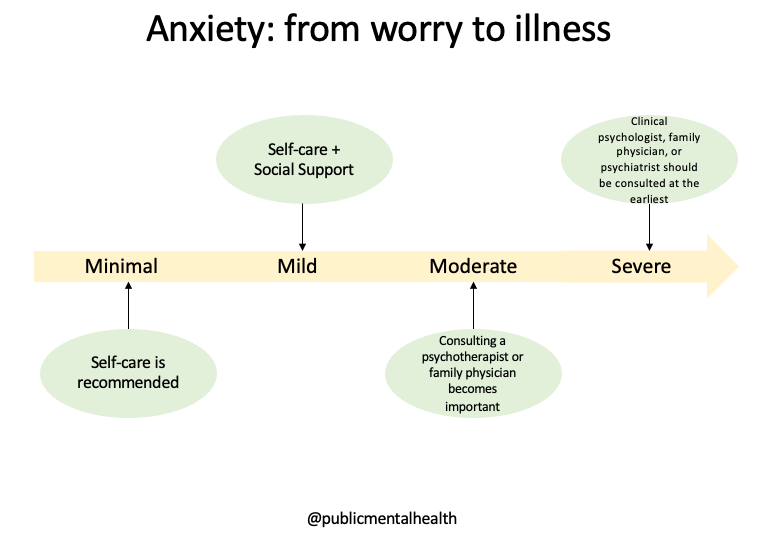
It is for clinical purposes that anxiety has been categorized as above, and to determine if medical intervention is needed. In practice, however, anxiety can be best defined by its level of severity based on the symptoms, their duration, and the extent to which they are disabling. There are many tools and questionnaires through which the severity of anxiety can be measured. Generalized Anxiety Disorder 7-item scale or commonly known as GAD-7 is one such tool for self-assessment of anxiety through which the severity of anxiety can be determined. It consists of 7 questions that ask you to rate your symptoms on a scale of 0–3. The questionnaire takes less than 3 minutes to complete, and the resulting score based on the responses can range anywhere between 0–21, giving a preliminary estimate of the severity of anxiety. The severity can be minimal, mild, moderate, and severe.
For minimal anxiety (total score=0–4), self-care and relaxation is recommended as it is considered part of a normal stress response.
For mild anxiety (total score=5–9), in addition to self-care, seeking social support from family members, friends, peers, or mentors is recommended. It is also important to monitor symptoms, and their severity consistently using self-assessment. Self-help resources and psycho education can also be useful; these can give insight into the possible causes for the symptoms and help develop positive coping strategies. Also, maintaining healthy routines, and use of stress-reduction techniques (e.g., mindfulness, exercise) can be helpful.
For moderate anxiety (total score=10–14), seeking psychotherapy becomes important. Counselors, social workers, peer support specialists, or other mental health workers can all be helpful. A physician can also be consulted to discuss the possibility of pharmacotherapy or referral to a specialist.
For severe anxiety (total score=15–21), professional help must be sought immediately. A clinical psychologist, family physician, or psychiatrist should be consulted at the earliest so that they can recommend appropriate treatment and next steps.
It’s important to note that the GAD‑7’s results are only indicative; it’s best to seek professional opinion in case of doubt.
Important Points to Remember
- Anxiety is common and treatable. It affects nearly 1 in 3 individuals at some point in life.
- Anxiety can start early. Symptoms often begin in childhood or adolescence and, if untreated, may persist into adulthood.
- Anxiety is not a sign of weakness. It is a clinical illness with underlying biological and psychological mechanisms. Neuroimaging and genetic studies show changes in the fear-regulation circuits of the brain and strong hereditary components in many anxiety disorders.
- Anxiety is not a choice and simply asking individuals to ‘calm down’ might not be helpful. In anxiety, the brain’s “alarm system” becomes overactive, triggering fear responses even in safe situations.
- Education and awareness help. Understanding that Anxiety is a treatable illness can reduce stigma and encourage people to seek timely support.
